Scratching the sofa: why the spray doesn't work, and what does
A cat that shreds the furniture is not being naughty and is not sharpening its claws. It is doing something it needs to do, in the best place it has found. Give it a better place and the sofa survives. What the post has to be like, where it has to go, and the mistakes that make it worse.
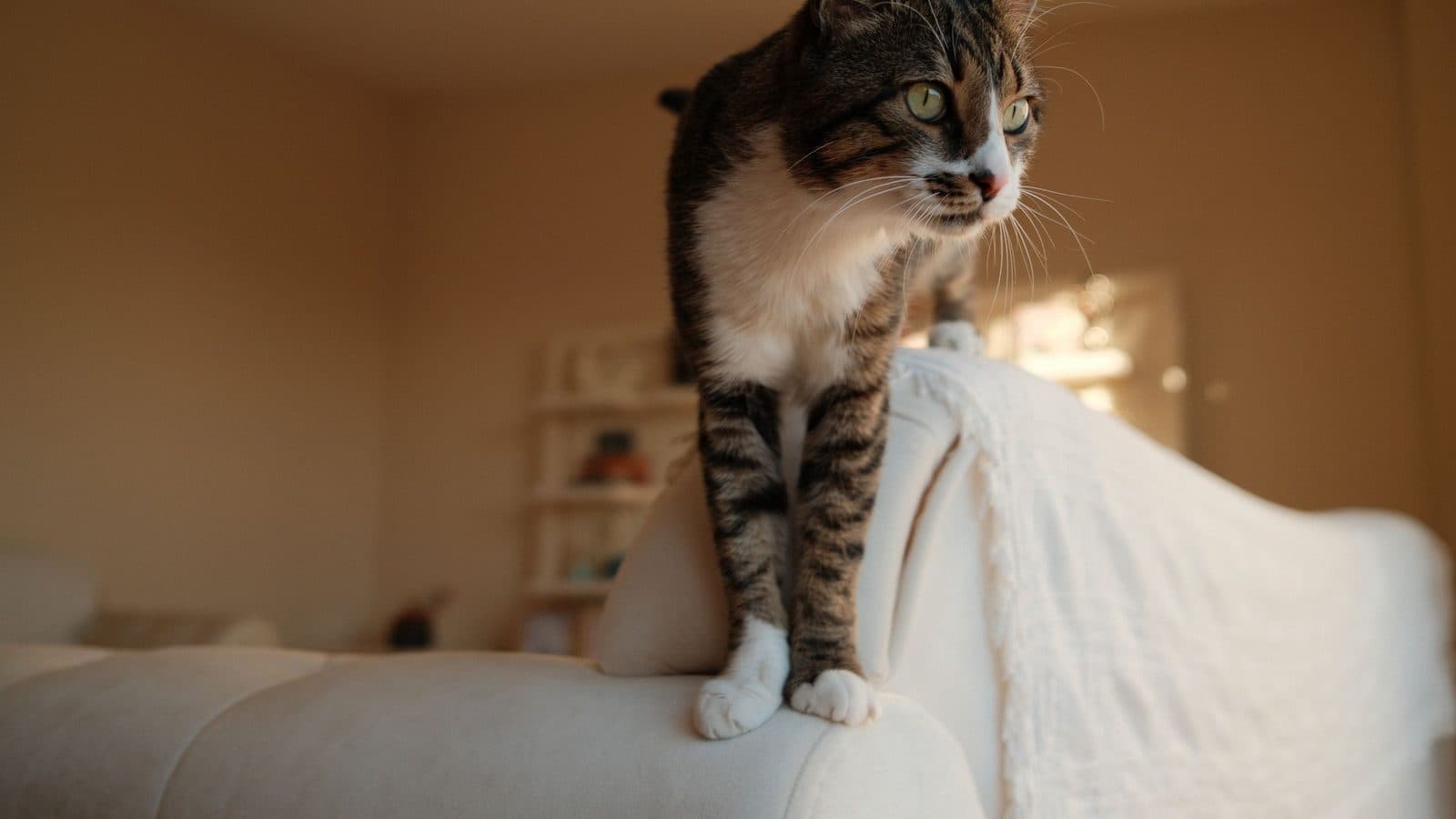
The arm of the sofa is in ribbons. There is a scratching post in the corner, bought for exactly this, untouched. You have tried the bitter spray, the water pistol, a firm "no", and the cat now scratches the sofa when you are out of the room instead.
Nearly every part of that story has a simple explanation, and it starts with what scratching is for.
Why cats scratch
Not to sharpen their claws, or not mainly. Scratching does four things at once:
- It sheds the outer claw sheath. Claws grow in layers, and scratching pulls off the worn outer husk. You find these pale crescents around a well-used post.
- It is a full-body stretch. Watch a cat scratch on waking: front claws anchored, spine extended, shoulders and back worked from toe to tail. For an animal built to sprint from a standing start, this is maintenance.
- It leaves a message. There are scent glands between the toes. A scratched surface carries both a visible mark and a chemical one that says, to the cat and to any other, "I live here". This is why cats scratch in prominent places and return to the same spot.
- It lets off feeling. Cats scratch when excited, when you come home, after a fright, and when the household is tense. An increase in scratching is often a stress signal.
It is a need, in the way that stretching is for you. It cannot be trained out, only trained somewhere. Every approach that tries to stop the behaviour fails; every approach that moves it works.
Why the sofa, and not the post
Look at what the cat chose. A sofa is heavy, so it does not move when pulled against. It is tall, so a full stretch is possible. It is covered in a woven fabric that claws sink into and drag through. It is in the middle of the room where the family is, which is where a territorial marker belongs. And it is beside where the cat sleeps.
Now the average shop-bought post: forty centimetres high, light enough to topple, covered in carpet, and placed out of the way in a corner of the spare room. From the cat's point of view it is worse than the sofa in every respect that matters. Ignoring it is the correct decision.
Why sprays and punishment fail
Deterrent sprays make one patch smell unpleasant for a few hours. They do nothing about the need, so the cat moves to the other arm, the carpet, or the side of the bed.
Punishment, shouting, clapping, a water pistol, is worse than useless. The cat does not connect it to the scratching, which it is driven to do, but to you. It learns to scratch when you are not there. And because punishment raises stress, and stress raises scratching, it increases the very thing it was meant to stop.
What the post has to be like
When several thousand owners were surveyed about what their cats actually used, the pattern was clear, and it matches what behaviourists recommend:
- Tall. At least 80–90 cm for an adult cat, so it can stretch to full length with its paws above its head. A big cat needs more.
- Immovable. A wide, heavy base, or fixed to a wall. If it wobbles once, many cats never return to it.
- The right texture. Sisal rope or sisal fabric suits most cats. Watch what yours chooses: a cat that scratches carpet or doormats wants a horizontal surface, and a flat corrugated cardboard scratcher, which costs a few euros, may be the best thing you ever buy. Many cats want both.
- Enough of them. One per cat, plus one, in different rooms.
A solid cat tree with sisal-wrapped legs does the job and gives height as well, which most cats value for its own sake.
Where it goes matters as much as what it is
- Right next to the damage. Against the scratched arm of the sofa, blocking it if possible. Not across the room. It can migrate later.
- Beside where the cat sleeps, because the first scratch of the day happens within seconds of waking.
- Near entrances and the routes the cat walks: by the front door, the patio door, the top of the stairs. These are the places a cat wants to mark.
- In the room where the people are. A post in an unused room marks nothing worth marking.
Yes, this means a scratching post in your living room. It can be a handsome one. It is still cheaper than a sofa.
Making the switch
Make the post attractive. Rub dried catnip or silvervine into the sisal. Drag a wand toy up it so the claws sink in during play. Scratch it with your own fingernails; the sound draws many cats. When the cat uses it, praise quietly or drop a treat at the base. Never carry the cat to the post and rub its paws on it. Cats dislike being handled that way and it poisons the post.
Make the sofa dull, for a few weeks. Wide double-sided tape on the scratched areas (cats dislike sticky paws), a fitted throw tucked in tightly, or clear plastic furniture guards. This is temporary: once the habit has moved to the post, the protection comes off.
Clean the old spot. The scent mark invites a repeat. Wipe the area with an enzymatic cleaner, or a little surgical spirit if the fabric allows.
Trim the claws every two to three weeks: just the clear, hooked tip, well clear of the pink quick. It does not reduce the urge, but it greatly reduces the damage. Start with one claw and a treat, and build up. Older cats need it most, because they scratch less and their claws overgrow.
Then move the post, if you must, a little at a time: half a metre every few days, to somewhere you prefer but still in the same room.
Most households see the furniture left alone within two to four weeks.
If the scratching is new, or everywhere
A sudden increase, or scratching that appears on door frames, window sills and several rooms at once, is usually marking driven by anxiety, not claw care. Ask what changed: a new cat in the house or outside the window, a new baby, building work, a move, a new routine. The answer then is the cause rather than more posts: more resources in a multi-cat home (trays, bowls, beds and perches for each cat, in separate places), blocked sight lines to the cat outside, safe high places, predictable play and feeding times, and a synthetic pheromone diffuser, which helps some cats. If it comes with spraying urine, over-grooming, or hiding, see the vet: pain and illness make cats mark too, and we have written about the signs of pain cats hide.
What never to do
Declawing is not a manicure. It is the amputation of the last bone of every toe. It causes lasting pain in many cats, changes how they walk, and is strongly linked to biting and to avoiding the litter tray. It is prohibited in almost every European country under animal-welfare law and under the European Convention for the Protection of Pet Animals, and no vet here should offer it.
Soft plastic nail caps glued over the claws are legal and sometimes used for a short period, for example to protect the skin of an elderly or immunocompromised person. They need replacing every few weeks, some cats cannot bear them, and they do nothing about the need to scratch. They are a stopgap, not a plan.
The short version
Buy a post that is as good as your sofa: tall, heavy, sisal. Put it exactly where the damage is. Make it smell of catnip and make the sofa briefly sticky. Trim the claws. Do not shout. In a month the cat is stretching on the post every morning, leaving little claw husks on the floor beside it, and the sofa has stopped being the best thing in the room.