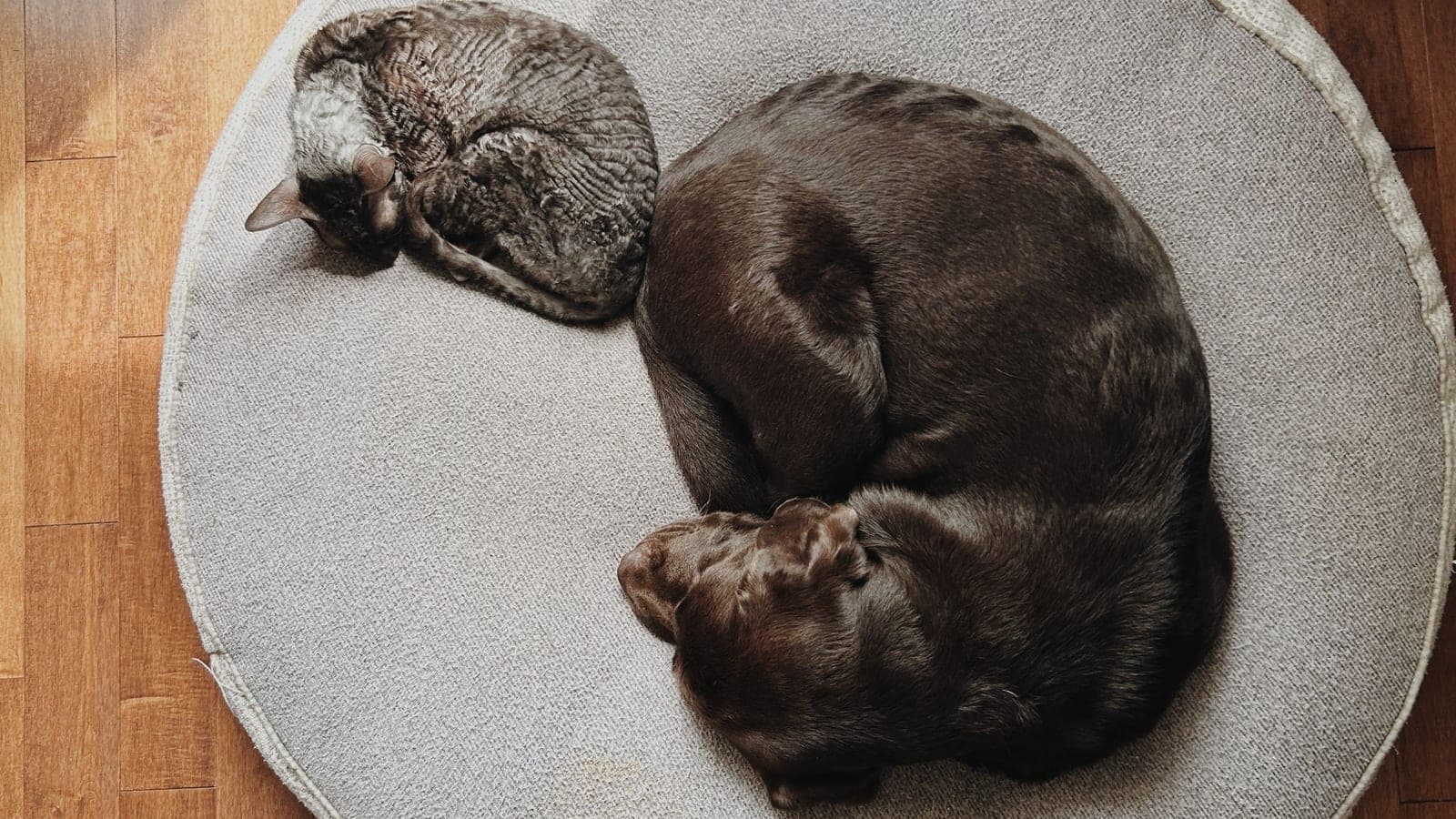
Not old, sore: the early signs of arthritis in dogs and cats that get mistaken for slowing down
Slow to get up, lagging on walks, no longer jumping onto the bed. Much of what gets called slowing down in an older dog or cat is joint pain, and pain can be treated. The early signs, six questions for cats, and what actually helps.

The first cold mornings of October are when many owners notice it. The dog who used to be at the door before you had your shoes on now takes a moment to get up: back legs first, a long stretch, then a few careful steps. The cat who slept on top of the wardrobe all summer has moved to the armchair. Somebody says "she's getting old", and everybody nods.
Age is the reason. It is not the explanation. In a great many older dogs and cats, what gets called slowing down is arthritis: joints that hurt. And unlike age, pain can be treated.
More common than anyone thinks
In one study, vets X-rayed every joint of 100 cats picked at random from one practice's patients, whether they were well or not, from under five years old to twenty. Ninety-two showed signs of joint disease somewhere, and the amount rose with every year of age. A Dutch study of 100 cats aged six and over found arthritis in at least one joint in 61 of them, and in more than one joint in 48. The cats with arthritis were the ones whose owners said they moved less, groomed less, and had started going outside the litter tray.
Not every joint that looks worn on an X-ray hurts. But the scale is the point: in cats, arthritis is normal in the sense of common, not in the sense of fine.
In dogs, a study of more than 450,000 dogs at British vets found that 2.5% were treated for arthritis in a single year, around 200,000 dogs in the UK alone, and those were only the ones whose owners had brought them in and come home with a diagnosis. The typical patient was over eight and heavier than average for its breed, with Labradors and golden retrievers near the top of the list. Once it started, it lasted on average for about a ninth of the dog's whole life.
Why it gets missed
- It comes slowly. A dog does not go from bounding to stiff overnight. It changes a little each month, and you adjust with it without noticing.
- It rarely looks like limping. Arthritis often affects both sides, both hips or both elbows, so there is no good leg to compare with. The animal simply moves less, and more carefully.
- Animals do not complain. A dog with sore hips still runs for the ball, because the ball matters more. The price is paid that evening, lying down. Cats, as we wrote in the signs of pain cats hide, hide it as a matter of survival.
- The vet rarely sees it. On a consulting table, full of adrenaline, an animal walks better than it has all week.
The early signs in a dog
None of these is dramatic. That is the point.
- Stiff after rest. Slow to get up after sleeping, or after lying down following a walk, then loosening up after a few minutes. This is the classic early sign, and it is usually worse in the morning.
- Hesitating at the stairs, the car, the sofa or the bed, or giving up on them. Taking stairs one at a time.
- Lagging on walks, turning for home sooner, or sitting down halfway.
- Sore the day after. Fine on a long weekend walk, stiff and quiet on Monday.
- Sitting differently, with one back leg kicked out to the side instead of tucked under, or lying down in stages.
- Licking one joint, often a wrist or a knee.
- Muscle loss over the back legs, so the hip bones and spine feel more prominent while the chest and shoulders do more of the work.
- A shorter temper, grumbling when touched over the hips or back, less patience with children or a younger dog.
- Restless nights, getting up and lying down again, changing position.
The questionnaire that vets at the University of Liverpool developed to measure arthritis in dogs asks about exactly these things, including how the dog's stiffness changes with the weather. Many owners notice it most on cold, damp days, and October is when those start.
The early signs in a cat, and six questions
Cats rarely limp. They change what they do. In 2020, researchers at North Carolina State University went through the data of five studies to find the questions that best separated cats with painful joints from cats without, and kept six. Does your cat do each of these normally, the way it did when it was younger?
- Run.
- Jump up.
- Jump down.
- Go up stairs or steps.
- Go down stairs or steps.
- Chase moving things, like a toy or a fly.
A "no" to any one of them is a good reason to ask your vet about pain. In the study, a "no" almost never came from a cat whose joints turned out to be fine. The questions did miss some: among owners who had been told nothing about arthritis, about half of the cats with painful joints passed all six, which says more about how well cats hide it than about the questions.
So watch for the quieter signs too: jumping in two stages by way of a chair, a coat that gets matted over the back and hips because twisting round to groom hurts, claws growing thick and long because scratching hurts, going next to the litter tray rather than in it, and a cat that no longer likes being picked up.
Your three things
The most useful thing you can do before the appointment takes five minutes. Write down three specific things your pet used to do and now does less, or differently. Not "she's slower", but:
- "Jumped onto our bed every night until about June. Now sleeps on the rug."
- "Took the stairs two at a time. Now one at a time, and waits at the bottom."
- "Walked for 45 minutes. Now turns for home at 25."
Pain researchers use this same method, asking owners to choose their own animal's activities and score them, because a specific change in an animal you know is a better measure than anything a vet can see in ten minutes. Add a thirty-second video of the dog getting up from its bed in the morning, or the cat jumping down from a chair. Later, the same three things are how you will judge whether the treatment is working.
They often show that it is. When the owners of 23 cats with joint pain scored their cats before and after four weeks of a pain-relief medicine, they saw improvement in every area they were asked about, moving, activity, grooming and temper, and the most in activity. Much of what had looked like age was pain.
What helps
Weight comes first
For an overweight dog with arthritis, losing weight is a treatment, not a side project. In a study of 14 obese dogs with arthritis, their lameness improved measurably once they had lost about 6% of their body weight, which is about 2 kg for a 35 kg dog. In another, nine overweight dogs with arthritic hips lost 11 to 18% on a measured diet, and their limping improved substantially with no other treatment.
For a young dog, it is prevention. In a lifelong study of 48 Labradors, half were fed a quarter less than their littermates from puppyhood. Arthritis in the hips first showed on X-rays at a median age of six in the fully fed dogs, and twelve in the lean ones, who also lived longer. The rib test in is your pet overweight? takes thirty seconds.
Movement: little and often
Arthritic joints do better with regular, moderate exercise than with rest, and much better than with a quiet week and a long Sunday hike.
- Two or three shorter walks rather than one long one, on soft ground where you can.
- About the same amount every day, so there are no big weekends.
- Swimming, or a water treadmill at a hydrotherapy centre if there is one near you.
- Fewer of the things that jolt: a ball thrown far, with its sudden stops and twists, and jumping down from the car.
- For cats, short play sessions with a toy on a string at floor level.
The house
- A thick, firm bed out of draughts. Many homes in southern Europe have stone or tiled floors, which are a cold, hard place for stiff joints to spend the night.
- Rugs or runners on slippery floors. A dog that slides on tiles strains every joint to stay upright.
- A ramp or a step for the car and the sofa, and a sturdy box or stool up to the cat's favourite windowsill.
- For cats, a litter tray with one low side on every floor they use, and food and water that are not at the top of a climb.
- Nails kept short, since long nails change how a dog stands.
Medicines, with your vet
- Anti-inflammatory painkillers made for dogs and for cats are the backbone of treatment and have been used for decades. Many animals take them for years, with blood tests now and then to keep an eye on the kidneys and liver.
- A monthly injection that blocks a pain signal called nerve growth factor has been available in Europe for dogs since 2020 and for cats since 2021. Many animals do very well on it. This year, though, vets have published reports of unusual, sometimes fast-progressing joint damage in some treated dogs and cats: one review of the maker's own safety reports described 186 dogs with unusual X-ray changes over five years. Reports like these cannot say how often it happens, and for cats the most reported side effects are skin problems. It is worth a direct conversation: what the options are, what to watch for, and whether X-rays first make sense.
- Other medicines can be added when one is not enough.
- Supplements: a review of the trials found reasonable evidence for only one, omega-3 fatty acids from fish oil in dogs, mostly as part of a joint diet. The evidence for glucosamine and chondroitin was weak. If you want to try something, ask your vet what and how much, and tell them what you give.
- Never a human painkiller. Paracetamol is deadly to cats, even a piece of a tablet. Ibuprofen, naproxen and aspirin can cause bleeding stomach ulcers and kidney failure in dogs at doses that look small. And a medicine prescribed for the dog is not safe for the cat.
When it is not arthritis
Arthritis creeps in. It does not arrive in a day. These need the vet the same day, not a joint plan:
- a sudden limp, or a leg held up and not used, which our piece on a sore paw or a cruciate goes through;
- a swollen or hot joint;
- crying out, or pain when you touch one spot;
- a cat that suddenly cannot use its back legs, especially if it cries, which can be a blood clot and is an emergency;
- weakness together with weight loss, drinking more, or not eating.
Making it a habit
Arthritis is easiest to manage when it is caught early, and it is caught early by owners, not by vets. Once a month, on a day you will remember, go through the dog list or the six cat questions, weigh your pet, and look at your three things. In mypet care a monthly repeating task does the remembering, the weight chart shows the slow drift nobody sees day to day, and if treatment starts, the medication list reminds you at each dose. Note any change on the pet's profile with the month it started. It is exactly what the vet will ask.
Then, the next time someone says the dog is just getting old, you will have a better question. Old, or sore?
Sources
- Lascelles BDX, Henry JB, Brown J, and colleagues. Cross-sectional study of the prevalence of radiographic degenerative joint disease in domesticated cats. Veterinary Surgery, 2010.
- Slingerland LI, Hazewinkel HAW, Meij BP, Picavet P, Voorhout G. Cross-sectional study of the prevalence and clinical features of osteoarthritis in 100 cats. The Veterinary Journal, 2011.
- Anderson KL, O'Neill DG, Brodbelt DC, and colleagues. Prevalence, duration and risk factors for appendicular osteoarthritis in a UK dog population under primary veterinary care. Scientific Reports, 2018.
- Walton MB, Cowderoy E, Lascelles D, Innes JF. Evaluation of construct and criterion validity for the 'Liverpool Osteoarthritis in Dogs' (LOAD) clinical metrology instrument. PLoS One, 2013.
- Enomoto M, Lascelles BDX, Gruen ME. Development of a checklist for the detection of degenerative joint disease-associated pain in cats. Journal of Feline Medicine and Surgery, 2020.
- Lascelles BDX, Hansen BD, Roe S, and colleagues. Evaluation of client-specific outcome measures and activity monitoring to measure pain relief in cats with osteoarthritis. Journal of Veterinary Internal Medicine, 2007.
- Bennett D, Morton C. A study of owner observed behavioural and lifestyle changes in cats with musculoskeletal disease before and after analgesic therapy. Journal of Feline Medicine and Surgery, 2009.
- Marshall WG, Hazewinkel HAW, Mullen D, and colleagues. The effect of weight loss on lameness in obese dogs with osteoarthritis. Veterinary Research Communications, 2010.
- Impellizeri JA, Tetrick MA, Muir P. Effect of weight reduction on clinical signs of lameness in dogs with hip osteoarthritis. Journal of the American Veterinary Medical Association, 2000.
- Smith GK, Paster ER, Powers MY, and colleagues. Lifelong diet restriction and radiographic evidence of osteoarthritis of the hip joint in dogs. Journal of the American Veterinary Medical Association, 2006.
- Kealy RD, Lawler DF, Ballam JM, and colleagues. Effects of diet restriction on life span and age-related changes in dogs. Journal of the American Veterinary Medical Association, 2002.
- Vandeweerd JM, Coisnon C, Clegg P, and colleagues. Systematic review of efficacy of nutraceuticals to alleviate clinical signs of osteoarthritis. Journal of Veterinary Internal Medicine, 2012.
- Budsberg SC, Clements DN, Regan DP, Wennemuth J. Atypical radiographic changes seen in dogs treated with bedinvetmab. Journal of the American Veterinary Medical Association, 2026.
- von Pfeil DJF, Armitage A, Nelson NC. Emerging signs of rapidly progressive arthritic changes in dogs and cats receiving bedinvetmab and frunevetmab. Veterinary and Comparative Orthopaedics and Traumatology, 2026.
- Lai X, Lin L, Chen Y, and colleagues. Safety assessment of frunevetmab for osteoarthritis pain in cats. Journal of Veterinary Internal Medicine, 2026.