The quietest health check: counting your pet's breaths while it sleeps, and why 30 is the number
Breathing that has quietly sped up in sleep is often the earliest sign of heart trouble in a dog or cat, well before a cough or a collapse. How to count it in a minute, what the studies say is normal, why your pet's own number matters most, and when a count means calling the vet.
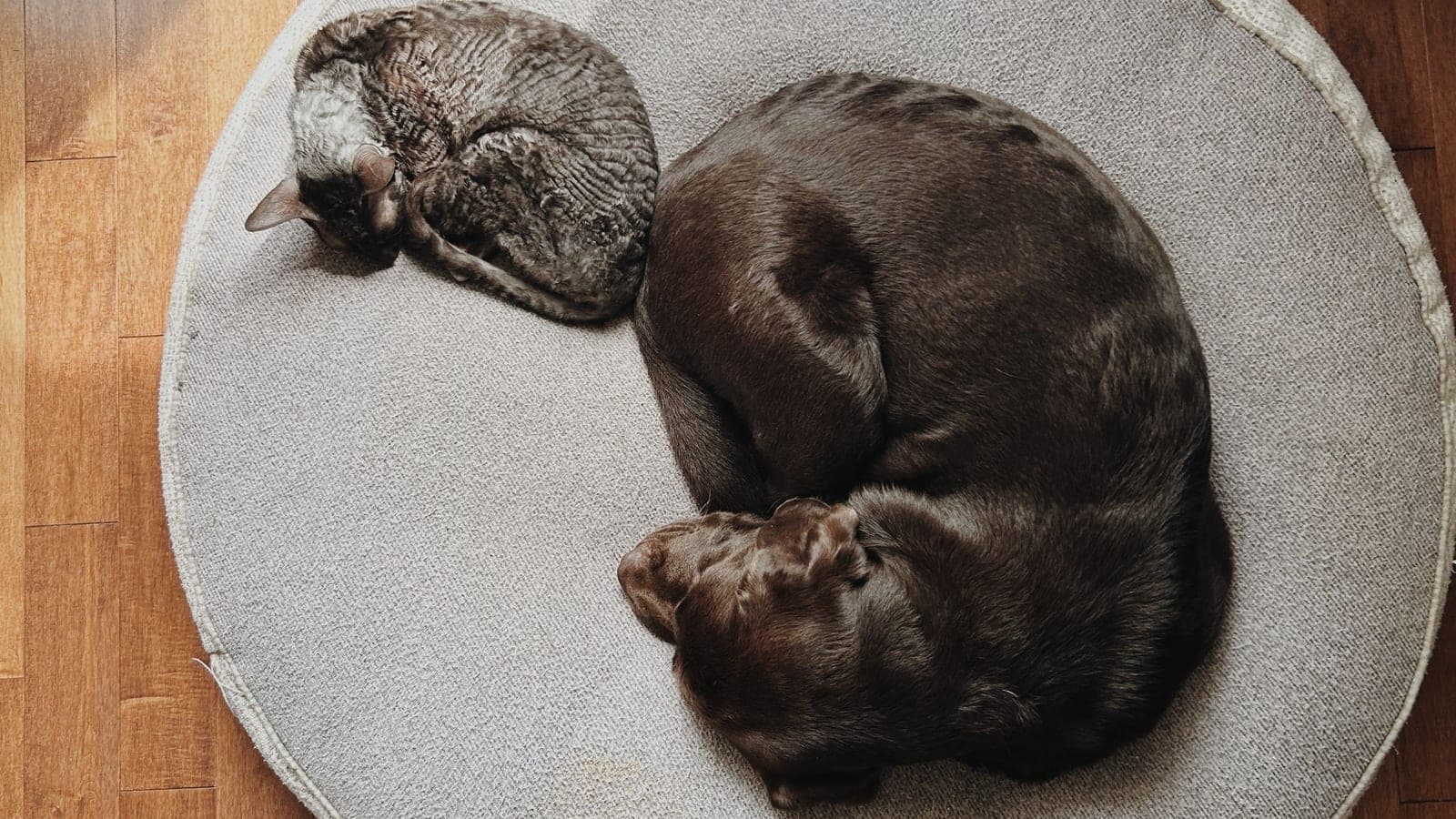
The dog is asleep against your leg. The cat has taken the warm end of the sofa. The television is on, nobody is doing anything, and the flank beside you rises and falls, rises and falls, as slow and even as a tide.
That rhythm is a measurement. It is one of the most useful numbers you can know about an animal's health. It costs nothing, takes a minute, and almost nobody collects it. Veterinary cardiologists ask the owners of their heart patients to count it every day, because breathing that has quietly sped up in sleep is often one of the earliest signs that heart failure is on its way, well before a cough, a collapse or a night at the emergency clinic.
You do not need a heart patient to start. You need a sleeping animal and a clock.
Why asleep, and why breathing
A pet's breathing rate is pushed around by almost everything: a walk, a warm room, the doorbell, a purr, a pant. Sleep strips most of that away. An animal deeply asleep in a comfortable room breathes at its own resting pace, and that pace turns out to be remarkably steady. When researchers asked owners to count their dogs and cats at home, eight to fourteen times over several weeks, each animal's number barely moved from one day to the next.
That steadiness is the whole point. A number that normally sits still and then starts to climb is telling you something.
How to count, in one minute
- Wait for deep sleep. Eyes closed, body loose, no paddling paws or flickering eyelids. An animal that is dreaming breathes irregularly and gives a high count. A cat must not be purring.
- Choose the moment. Not straight after a walk, a game or a big meal, and not in a hot room or a patch of sun. Heat raises the rate in any animal.
- Watch the flank or the chest. One rise and one fall is one breath. In a long coat or dim light, fix your eyes on a single patch of fur against the edge of the sofa or a line in the blanket, and count its movements.
- Count for a full minute on your phone's timer, or for thirty seconds and double it.
- Write it down, with the date. A single number means little. A list of them is the tool.
After the second time, it takes less effort than choosing what to watch next.
What normal looks like
The best information comes from studies in which owners, not vets, did the counting, at home, exactly as above.
| Who was counted | Sleeping breaths per minute |
|---|---|
| 114 healthy adult dogs | Average about 13 to 15. No dog averaged above 23. |
| 190 dogs with heart disease that was not yet causing symptoms | Average 16, and generally below 25. |
| Healthy adult cats | Middle of the range about 21. Averages below 30. |
So most healthy adult dogs and cats sleep at somewhere between ten and twenty-five breaths a minute, and the line veterinary cardiologists use is 30. A pet whose sleeping count is consistently above 30 is breathing faster than healthy animals almost ever do, and that is worth a call to the vet. For cats already being treated for heart disease, the specialist guidelines set keeping the count under 30 as the aim of treatment.
A few things the numbers also show. In dogs, size and age made no difference: a Chihuahua and a mastiff sleep at much the same rate. In cats, age made a small one. The figures are for adults, since puppies and kittens breathe faster. And a low count is not a worry in an animal that is otherwise well. A dog that sleeps at ten breaths a minute is simply a very calm sleeper.
Your pet's own number matters more
The averages tell you where the line is. Your animal's own record tells you whether anything has changed long before it gets there.
Count once a day for a week to learn your pet's usual number, then settle into once a week. Here is how a record might look for a cat whose usual is about 18:
| When | Sleeping count |
|---|---|
| First four Sundays | 18, 17, 19, 18 |
| Fifth Sunday | 22 |
| Sixth Sunday, and the two nights after | 26, 27, 25 |
Nothing on that list reaches 30. But a cat that slept at 18 for a month and now sleeps at 26, night after night, has changed, and the change is the point. Cardiologists say the same: for some animals a count below 30 is already abnormal, and your vet may give you a lower number to watch for. That record is worth a phone call, and it is exactly what the vet will want to see.
Why breathing changes before anything you would notice
The left side of the heart takes blood from the lungs and pumps it round the body. When it begins to fail, whether through a leaking valve in a small dog or a thickened muscle in a cat, blood backs up into the lungs and fluid seeps out of the vessels into the lung tissue. Wet lungs are stiff, and stiff lungs are breathed with smaller, quicker breaths. The animal is not in visible distress. It is simply breathing a little faster all the time, asleep included.
A large international study followed dogs with a leaking mitral valve and an enlarged heart, many of whom went on to develop heart failure. Of everything measured, from heart rate to body weight, the breathing rate changed the most, and it rose most steeply in the period just before heart failure set in. Part of that rate was counted by the owners, at home. The early warning is in your living room.
Who should be counting
Anyone can, and a record taken while an animal is healthy is worth having for later. For some pets, though, it is worth making a habit now.
- Small and medium dogs from middle age. A slowly degenerating, leaking mitral valve is the commonest heart disease in dogs, and mostly one of smaller breeds: Chihuahuas, dachshunds, poodles, Yorkshire terriers and above all Cavalier King Charles spaniels, about half of whom have a heart murmur by the age of five and nearly all by ten.
- Any dog or cat told it has a heart murmur. A murmur is a sound, not a diagnosis, and in cats many are harmless: in one large study, four in ten apparently healthy cats had one, and most were judged innocent. But a murmur is the moment to start counting, because the count is how you will know if it begins to matter.
- Cats, all of them. In the same study, of 780 apparently healthy cats in rehoming centres, about one in seven had hypertrophic cardiomyopathy, a thickening of the heart muscle. It was more common in older cats, in males, and in cats carrying extra weight. Every one of them had looked healthy. Cats hide illness until it is advanced, rarely cough from heart disease, and the first sign an owner sees is often a crisis. The sleeping count is one of the very few early signs a cat owner can catch.
- Large breeds with a known heart risk, such as Dobermanns and Great Danes, which are prone to a weakened, dilated heart muscle.
- Any pet already on heart medication. Count every day. It is how the dose gets adjusted, often by phone, without a trip to the clinic.
What a count means, and what to do
- Under 30 and close to its usual number: nothing to do. Keep counting once a week.
- One count over 30: count again two or three times over the next couple of hours, in deep sleep, in a cool room. A single high number is usually a dream or a warm evening.
- Consistently over 30, or clearly above your pet's usual for several nights: phone the vet and ask for a check within a day or two. Take the list, and mention anything else that has changed: appetite, energy, a cough, restless nights, a reluctance to lie down.
- Go now, day or night, if a fast count comes with any of these:
- breathing that looks like work: the belly pushing with each breath, elbows held out, neck stretched forward;
- restlessness, being unable to settle, or sitting up to breathe;
- a cat breathing with its mouth open;
- gums that are grey, blue or very pale;
- weakness, collapse or fainting;
- in a cat, sudden weakness or paralysis of the back legs, often with crying: a blood clot, and an emergency in its own right.
Things that raise the count and are not the heart
A raised count is a reason to ask, never a diagnosis on its own. Heat, a recent run, stress, dreaming and purring all push it up for a while. So do pain, fever, anaemia, diseases of the lungs and airways, and some medicines: steroids, for one, make many dogs pant. Flat-faced breeds such as pugs and French bulldogs often breathe noisily in their sleep, which is a problem of its own worth raising with the vet, but the count means the same for them as for anyone.
Sorting one cause from another is the vet's job. Yours is to notice the change and bring the record, which, as with everything you take to an appointment, turns "he seems a bit off" into something a vet can act on.
Making it a habit
The count only works if it happens while nothing seems wrong, which is exactly when nobody thinks of it. Tie it to something that already happens every week: the evening the bins go out, the Sunday film, the last cup of tea. A repeating task in mypet care, something like "Count Luna's breaths while she sleeps", makes sure the week does not slip by; for a pet on heart treatment, make it daily. If the vet does start medication, the medication list in the app reminds you at each dose, too. Keep the numbers with their dates somewhere you will not lose them, and take them to every check-up.
Tonight, when the house is quiet and the animal beside you is asleep, set a timer for a minute and count. The first number means very little. The tenth is a baseline. And one evening, perhaps years from now, the number that is different will be the one that gets your pet to the vet in time.
Sources
- Rishniw M, Ljungvall I, Porciello F, Häggström J, Ohad DG. Sleeping respiratory rates in apparently healthy adult dogs. Research in Veterinary Science, 2012.
- Ohad DG, Rishniw M, Ljungvall I, Porciello F, Häggström J. Sleeping and resting respiratory rates in dogs with subclinical heart disease. Journal of the American Veterinary Medical Association, 2013.
- Ljungvall I, Rishniw M, Porciello F, Häggström J, Ohad D. Sleeping and resting respiratory rates in healthy adult cats and cats with subclinical heart disease. Journal of Feline Medicine and Surgery, 2014.
- Boswood A and colleagues. Temporal changes in clinical and radiographic variables in dogs with preclinical myxomatous mitral valve disease: the EPIC study. Journal of Veterinary Internal Medicine, 2020.
- Payne JR, Brodbelt DC, Luis Fuentes V. Cardiomyopathy prevalence in 780 apparently healthy cats in rehoming centres (the CatScan study). Journal of Veterinary Cardiology, 2015.
- Luis Fuentes V and colleagues. ACVIM consensus statement guidelines for the classification, diagnosis, and management of cardiomyopathies in cats. Journal of Veterinary Internal Medicine, 2020.
- Cardiac Education Group. Monitoring your pet's respiratory (breathing) rate, information for pet owners, 2015.
- Science for Animal Welfare (UFAW). Mitral valve disease in the Cavalier King Charles spaniel.